Meaning Of Word 'Sai' As Explained By Shri Ramkrishna Paramhans
Sai devotees always chant the word 'Sai'. It has become a mantra for them. But very few people know its meaning.
The meaning of 'Sai' could be very well understood by reading 'Shri Ramkrishna Vachnanamrut' . One would be surprised to know that the meaning of the word is similar to the life of Sai Baba. It is more surprising that when Shri Ramkrishna Paramhans explained it, he was living in Bengal. Before we proceed to analyse the meaning of the word 'Sai', first some similarities between he lifestyle of Shri Ramkrishna Paramhans and Shirdi Sai Baba has to studied as the meaning has some relation of it.
Shri Ramkrishna Paramhans and Shirdi Sai Baba lived in almost similar ages. Shri Ramkrishna Paramhans birth was in the year 1837 and Sai Baba's birth was in the year 1838 (approximately) . Both the saints had similarities in their thoughts and teachings. Both had said that all the religions are one. People of all religion go to the same God. People of all religions should live with brotherhood following this rule. Ram of Hindus, Allah of Muslims and Jesus of Christians are one and same. People call them by such names according to their castes and creed, but in the end they are calling only one God.
Both the saints have put the same question that though there exists similarity of Gods, then why people quarrel with each other? Why do they behave live fools? So it was emphasized that people should live in unison. Though the paths are different, everybody has to go the same place. It is said that saints know each other and are one with each other.
Once Shri Ramkrishna Paramhans was seated in a room of Dakshineshwar temple. The author of famous work 'Shri Ramkrishna Vachnamrut', Shri Master Maharaj was also present. At that time, Shri Ramkrishna Paramhans had explained the meaning of 'Sai' in his pravachan, "In the opinion of power, the one who has acquired the world i.e. a Siddha Purush is said to be Koul, according to Vedant, it is Paramhans, so according to Boul Vaishnav (a sub custom of Bengal) it is called Sai. Boul Vaishnav of Bengal and Varkari of Maharastra are similar. So Sai is the last limit. When Boul's became Siddha, it is called 'Sai'. There is total indifference in this situation. The people wear a necklace of which is half made up of cow's bones and the other half is made up of tulsi (Tulsi is herb considered as auspicious as per Hindu tradition). This Siddha person follow and respect both Hindu and Muslim religion. He is 'Neer" for Hindus and a 'Peer' for Muslims.
In this way, Shri Ramkrishna Paramhans has explained the meaning of word 'Sai'. We can see the character of Sai Baba same as the meaning. Shri Ramkrishna Paramhans used to sing a bhajan "Ek Aise Bhavka Fakir Aayaa Hai, Jo Hidnuo Ka Devataa Aur Musalamano Ka Peer Hai"
One more surprising fact is that in the year 1886, Sai Baba took Samadhi for three days and in the same year, Shri Ramkrishna Paramhans had taken Samadhi. Saints only know their deeds, but there is no doubt that they both were one. They both knew each other's deeds.
Thus it is clear from this that when Sai Baba first came to Shirdi, Goddess Saraswati only spoke in the voice of Mhalsapati 'Come Sai'.
Source : Translated from Gujarati Magazine 'Dwarkamai'
--
OM Sai Ram
Showing posts with label God. Show all posts
Showing posts with label God. Show all posts
Tuesday, October 25, 2011

LAKSHMI POOJA – Deeper Meaning
LAKSHMI POOJA – Deeper Meaning
1. What does the word Lakshmi mean?
The word Lakshmi comes from 'laksha' means 'to aim at'. So 'Lakshmi' is that,what is sought after by all.
2. Whois Goddess Lakshmi?
· In the Puranas she is said to be the consort of Lord Narayana.
· She is the 'Adi Shakti', the eternal power of the Lord.
· She has various aspects or expressions.
3. Whoshould seek blessings from Goddess Lakshmi?
·Scriptures talk of two paths. Path of Action (Pravritti marga) and Path ofRenounciation (Nivritti marga). All those who want either pleasures orliberation, following their respective paths should seek blessings from GoddessLakshmi.
4. Howshould one following 'the Path of Action' seek goddess Lakshmi?
In Ishaavaasya Upanishad 2nd mantra it is said, 'kurvan eva iha karmaanijijivishet shatam samaah; evam tvayi naanyathetosti na karma lipyate nare'
Those who wish to desire pleasures of this world and higher worlds (heavens)should aim to live a long life of dharma, serving others.
One requires wealth to live a long life of service. Hence one must work hard toacquire wealth.
·
When the wealth acquired righteously is used for dharma then the actionsperformed to acquire wealth do not bind the doer with I-ness and My-ness.
5. What kind of wealth is sought after by those who follow the Path of Action?
· There are eight types of wealth described in the scriptures, called as AshtaLakshmi.
6.What are the eight types of wealth?
1) Dhana Lakshmi: Money through righteous ways
2) Dhaanya Lakshmi: Sattvik pure food to maintain health. As health is wealth.
3) Gaja Lakshmi: Cattle or vehicle.
4) Santaan Lakshmi: Good and well behaved children.
5) Vidyaa Lakshmi: Proficiency in the world
6) Dhairya Lakshmi: Courage to venture into new things and also facedifficulties.
7) Vijaya Lakshmi: Success in ones field of action
8) Aadi Lakshmi: She being the eternal power of the Lord is also the eternalsource of grace and hence when sought after one will never be denied of Herblessings.
7. InTulasi Ramayana Seetaji is worshiped as Adi Shakti.'udbhava-sthiti-samhaara-kaarinim klesha-haarinim, sarva-shreyas-karim seetaamnato ham Rama-vallabhaam.' She is the very cause of creation maintainance anddissolution of the world. When She is with Rama, She removes all the klesha(Avidya-ignorance of Self, Asmita- I-ness, Rraga-likes, Dvesha-dislikes andAbhinivesha-fear of death because of identification with the limited) andbrings ultimate good (Moksha). But the same Adi shakti, eternal power of theLord if is not with the Lord can create klesha and bring ultimate destruction.Lord Narayana pervades the world of names and forms. Hence service to all isservice to the Lord. Jana seva Jananrdan seva, nara seva Narayana Seva. Hencewealth when utilised for dharma, service to all will bring the Ultimate Good,Moksha through antahkarana shuddhi (purification of the mind).
8. Howshould one following 'the Path of Renunciation' seek goddess Lakshmi?
Ishaavaasya Upanishad in the first mantra says, 'ishaa-vaasyam idam sarvam yatkinchit jagatyaam jagat; tena tyaktena bhunjithaah maa gridha kasyaswitdhanam'.
Those who do not desire temporary pleasures of this world or the higher worldsand are the seekers of the permanent bliss should not hoard wealth and protectthemselves from the attachment to the transient.
Permanent happiness is possible only when one is able to experience The Onepervading the apparent many. To whom then the wealth belongs to when there Isnothing other then the One?
The seekers of the One, prepare themselves to walk the Path of Renunciation bycultivating the fourfold qualities such as Vivek (ability to discriminatebetween the permanent and the impermanent), Vairagya (giving up theidentification with the impermanent), Shat Sampatti (Six wealth) andMumukshutvam (desire to get liberated from the limited).
Thus the seekers of the Truth too seek blessings of Goddess Lakshmi for the'Shat Sampati', six kind of wealth.
9.What are the six types of wealth required by the seekers of the Truth?
1) Shama - Control of mind. The mind does not distract the seeker.
2) Dama - Control of senses. The seeker does not get lured by the falseglitters of the sense objects.
3) Uparati - Not persecuted by the mind and senses, the seeker is able topractice ones own dharma, 'swadhyaaya'.
4) Titikshaa - Forbearance. The seeker's knowledge of 'The Oneness' does notshake while experiencing the pairs of opposite like 'sukha-dukha' etc.
5) Shraddhaa - Faith in the words of Guru and Vedanta which helps the seeker toremain consistent till the goal is reached.
6) Samaadhaanam - Single-pointedness of mind. Where the mind rests in the One.
10.Thus whether one wants Dharma or Brahma we need the blessings of GoddessLakshmi. Worshiping Goddess Lakshmi means in adoration humbly surrender toinvoke Her grace.
11.The highest wealth is Narayana, the Poorna-the infinite. Having attained thatone becomes free from wants. Wealth without Lord Narayana makes us dependentslaves and beggars of more. Laksmiji finds Her fulfilment in being one withNarayana.
12.Gurudev once said, 'Hold on to Narayana, Lakshmi will follow.' The easiest wayto invoke Lord Narayana in kaliyuga is to chant the name of the Lord. Let usincrease the wealth of the name - 'Naam dhan kaa khajaanaa badhaate chalo apnimukti kaa maarg banaate chalo' and pave our path to liberation.
13.May Mother Lakshmi protect us and bless us with Lord Narayana, The Infinite.
From Chinamaya Mission.
1. What does the word Lakshmi mean?
The word Lakshmi comes from 'laksha' means 'to aim at'. So 'Lakshmi' is that,what is sought after by all.
2. Whois Goddess Lakshmi?
· In the Puranas she is said to be the consort of Lord Narayana.
· She is the 'Adi Shakti', the eternal power of the Lord.
· She has various aspects or expressions.
3. Whoshould seek blessings from Goddess Lakshmi?
·Scriptures talk of two paths. Path of Action (Pravritti marga) and Path ofRenounciation (Nivritti marga). All those who want either pleasures orliberation, following their respective paths should seek blessings from GoddessLakshmi.
4. Howshould one following 'the Path of Action' seek goddess Lakshmi?
In Ishaavaasya Upanishad 2nd mantra it is said, 'kurvan eva iha karmaanijijivishet shatam samaah; evam tvayi naanyathetosti na karma lipyate nare'
Those who wish to desire pleasures of this world and higher worlds (heavens)should aim to live a long life of dharma, serving others.
One requires wealth to live a long life of service. Hence one must work hard toacquire wealth.
·
When the wealth acquired righteously is used for dharma then the actionsperformed to acquire wealth do not bind the doer with I-ness and My-ness.
5. What kind of wealth is sought after by those who follow the Path of Action?
· There are eight types of wealth described in the scriptures, called as AshtaLakshmi.
6.What are the eight types of wealth?
1) Dhana Lakshmi: Money through righteous ways
2) Dhaanya Lakshmi: Sattvik pure food to maintain health. As health is wealth.
3) Gaja Lakshmi: Cattle or vehicle.
4) Santaan Lakshmi: Good and well behaved children.
5) Vidyaa Lakshmi: Proficiency in the world
6) Dhairya Lakshmi: Courage to venture into new things and also facedifficulties.
7) Vijaya Lakshmi: Success in ones field of action
8) Aadi Lakshmi: She being the eternal power of the Lord is also the eternalsource of grace and hence when sought after one will never be denied of Herblessings.
7. InTulasi Ramayana Seetaji is worshiped as Adi Shakti.'udbhava-sthiti-samhaara-kaarinim klesha-haarinim, sarva-shreyas-karim seetaamnato ham Rama-vallabhaam.' She is the very cause of creation maintainance anddissolution of the world. When She is with Rama, She removes all the klesha(Avidya-ignorance of Self, Asmita- I-ness, Rraga-likes, Dvesha-dislikes andAbhinivesha-fear of death because of identification with the limited) andbrings ultimate good (Moksha). But the same Adi shakti, eternal power of theLord if is not with the Lord can create klesha and bring ultimate destruction.Lord Narayana pervades the world of names and forms. Hence service to all isservice to the Lord. Jana seva Jananrdan seva, nara seva Narayana Seva. Hencewealth when utilised for dharma, service to all will bring the Ultimate Good,Moksha through antahkarana shuddhi (purification of the mind).
8. Howshould one following 'the Path of Renunciation' seek goddess Lakshmi?
Ishaavaasya Upanishad in the first mantra says, 'ishaa-vaasyam idam sarvam yatkinchit jagatyaam jagat; tena tyaktena bhunjithaah maa gridha kasyaswitdhanam'.
Those who do not desire temporary pleasures of this world or the higher worldsand are the seekers of the permanent bliss should not hoard wealth and protectthemselves from the attachment to the transient.
Permanent happiness is possible only when one is able to experience The Onepervading the apparent many. To whom then the wealth belongs to when there Isnothing other then the One?
The seekers of the One, prepare themselves to walk the Path of Renunciation bycultivating the fourfold qualities such as Vivek (ability to discriminatebetween the permanent and the impermanent), Vairagya (giving up theidentification with the impermanent), Shat Sampatti (Six wealth) andMumukshutvam (desire to get liberated from the limited).
Thus the seekers of the Truth too seek blessings of Goddess Lakshmi for the'Shat Sampati', six kind of wealth.
9.What are the six types of wealth required by the seekers of the Truth?
1) Shama - Control of mind. The mind does not distract the seeker.
2) Dama - Control of senses. The seeker does not get lured by the falseglitters of the sense objects.
3) Uparati - Not persecuted by the mind and senses, the seeker is able topractice ones own dharma, 'swadhyaaya'.
4) Titikshaa - Forbearance. The seeker's knowledge of 'The Oneness' does notshake while experiencing the pairs of opposite like 'sukha-dukha' etc.
5) Shraddhaa - Faith in the words of Guru and Vedanta which helps the seeker toremain consistent till the goal is reached.
6) Samaadhaanam - Single-pointedness of mind. Where the mind rests in the One.
10.Thus whether one wants Dharma or Brahma we need the blessings of GoddessLakshmi. Worshiping Goddess Lakshmi means in adoration humbly surrender toinvoke Her grace.
11.The highest wealth is Narayana, the Poorna-the infinite. Having attained thatone becomes free from wants. Wealth without Lord Narayana makes us dependentslaves and beggars of more. Laksmiji finds Her fulfilment in being one withNarayana.
12.Gurudev once said, 'Hold on to Narayana, Lakshmi will follow.' The easiest wayto invoke Lord Narayana in kaliyuga is to chant the name of the Lord. Let usincrease the wealth of the name - 'Naam dhan kaa khajaanaa badhaate chalo apnimukti kaa maarg banaate chalo' and pave our path to liberation.
13.May Mother Lakshmi protect us and bless us with Lord Narayana, The Infinite.
From Chinamaya Mission.
Monday, September 12, 2011


Wednesday, August 31, 2011
Happy and Successful Ganesh Chaturthi
Happy and Successful Ganesh Chaturthi

We wish a very happy and successful Ganesh Chaturthi to all my friends
Ganesh chaturthi is fast approaching and you might be excited to celebrate it with gusto. This year (2011) on September starts the gala celebrations of Ganesh chaturthi. Yes. We all celebrate. But would you like to know the spirit that makes the celebrations more meaningful?! Please read on to know!
Ganesh chaturthi is one of the grandest and most elaborate festivals that Indians celebrate. Especially in the state of Maharastra, Ganesh chaturthi is celebrated for 10 days. It begins on the fourth day of shukla chaturthi and ends on the day of ananta chaturdasi. The power of Lord Ganesha is invoked on the first day; worshipped elaborately in decorated pandals for 9 days; and on the tenth day he is bid farewell by immersing in water bodies.
But now-a-days Ganesh chaturthi is celebrated just as some mundane party or get-together, aiming only at external activities. You might have noticed such a thing in the places where mass of people sing mundane cinema songs and dance wildly without knowing what are they doing this for. There is no connection to Lord Ganesh. Some do not even know who is Lord Ganesha and what is his significance. This is sorry state of affair.
Celebrations of Ganesh chaturthi festival can be meaning only by knowing the philosophy behind Lord Ganesh and contemplating his significance in one’s life.
Significance of Lord Ganesha Hindu scriptures describe Ganesha as son of Lord Shiva, who is empowered to remove obstacles in the path of success. He is one of the five prime Hindu deities. He is worshipped at the beginning of every major venture. He is glorified in following vedic mantra:
Mushikavaahana modaka hastha,
Chaamara karna vilambitha sutra,
Vaamana rupa maheshwara putra,
Vighna vinaayaka paada namasthe
“O Lord Vinayaka! the remover of all obstacles, the son of Lord Shiva, with a form which is very short, with mouse as Thy vehicle, with sweet pudding in hand, with wide ears and long hanging trunk, I prostrate at Thy lotus-like Feet!”
Lord Ganesha should be worshipped with great reverence and respect. It is best celebrated with the spirit of enthusiasm for wisdom and knowledge. One should take resolutions on the day of Ganesha chaturthi. One should contemplate what is the goal of his or her life and how to achieve that goal. What are the obstacles on the way of your goal. What is your idea of success. Then you should pray to Lord Ganesha for help in achieving the goal. This is the real meaning of worshipping Lord Ganesha.
Lord Ganesha is pleased when the devotee prays for success of all humanity. Ganesh chaturthi should unify all and direct everyone towards the success of human life, salvation.
We wish a very happy and successful Ganesh Chaturthi!
Saturday, September 11, 2010
Happy Ganesh Chaturthi
Happy Ganesh Chaturthi

Wishing you, your family & all your fb friends very Happy Ganesh Chaturthi :-)
- May Lord Ganesh bring you Good Luck and Prosperity.
- Wish you a blessed Ganesh Chaturthi and many Properous days ahead.
- May Lord Ganesha bestow Success, Happiness and Prosperity upon you and your Family.
- May Lord Ganesha shower on you Love and Joy, Peace and Prosperity this Ganesh Chaturthi.
- May Lord Ganesha shower his blessings on you always.
- May God Ganesha bless you with Power and Wisdom Happy Ganesha Pooja.
- May the Lord Ganesh remove all obstacles and shower you with bounties.
- Wish you be accompanied with Auspicious and blessings on Ganesha Pooja.
- May Lord Ganesha and his blessings be with you Always.
- May Lord Ganesha fullfill your all the Dreams and Wishes.
- May the Blessings of Lord Ganesha Continue to Shine on you and your Family.
- I wish Joy, Harmony and Prosperity on Ganesh Pooja for you and your Family.
- I wish you Happy Ganesh Chaturthi and I pray to God for your prosperous life.
Om Gang Ganpataya Namoh Namah, Shri Siddhi Vinayak Namo Namahah, Asta Vinayak Namo Namaha, Ganpati Bapa Morya :-)
Monday, June 14, 2010

Tuesday, March 30, 2010


Thursday, July 9, 2009
108 Names of Lord Ganesh
108 Names of Lord Ganesh
Names Meanings
Akhuratha One who has Mouse as his Chariot/Vehicle
Alampata Ever Eternal Lord
Amit Incomparable Lord
Anantachidrupamayam Infinite and Consciousness Personified
Avaneesh Lord of the whole World
Avighna Remover of Obstacles
Balaganapati Beloved and Lovable Child
Bhalchandra Moon-Crested Lord
Bheema Huge and Gigantic
Bhupati Lord of the Gods
Bhuvanpati God of the Gods
Buddhinath God of Wisdom
Buddhipriya Knowledge Bestower
Buddhividhata God of Knowledge
Chaturbhuj One who has Four Arms
Devadeva Lord of All Lords
Devantakanashakarin Destroyer of Evils and Asuras
Devavrata One who accepts all Penances
Devendrashika Protector of All Gods
Dharmik One who gives Charity
Dhoomravarna Smoke-Hued Lord
Durja Invincible Lord
Dvaimatura One who has two Mothers
Ekaakshara He of the Single Syllable
Ekadanta Single-Tusked Lord
Ekadrishta Single-Tusked Lord
Eshanputra Lord Shiva's Son
Gadadhara One who has The Mace as His Weapon
Gajakarna One who has Eyes like an Elephant
Gajanana Elephant-Faced Lord
Gajananeti Elephant-Faced Lord
Gajavakra Trunk of The Elephant
Gajavaktra One who has Mouth like an Elephant
Ganadhakshya Lord of All Ganas
Ganadhyakshina Leader of All The Celestial Bodies
Ganapati Lord of All Ganas
Gaurisuta The Son of Gauri
Gunina One who is The Master of All Virtues
Haridra One who is Golden Colored
Heramba Mother's Beloved Son
Kapila Yellowish-Brown Colored
Kaveesha Master of Poets
Kirti Lord of Music
Kripalu Merciful Lord
Krishapingaksha Yellowish-Brown Eyed
Kshamakaram The Place of Forgiveness
Kshipra One who is easy to Appease
Lambakarna Large-Eared Lord
Lambodara The Huge Bellied Lord
Mahabala Enormously Strong Lord
Mahaganapati Omnipotent and Supreme Lord
Maheshwaram Lord of The Universe
Mangalamurti All Auspicious Lord
Manomay Winner of Hearts
Mrityuanjaya Conqueror of Death
Mundakarama Abode of Happiness
Muktidaya Bestower of Eternal Bliss
Musikvahana One who has Mouse as His Charioteer
Nadapratithishta One who Appreciates and Loves Music
Namasthetu Vanquisher of All Evils and Vices and Sins
Nandana Lord Shiva's Son
Nideeshwaram Giver of Wealth and Treasures
Omkara One who has the Form Of OM
Pitambara One who has Yellow Colored Body
Pramoda Lord of All Abodes
Prathameshwara First Among All
Purush The Omnipotent Personality
Rakta One who has Red Colored Body
Rudrapriya Beloved Of Lord Shiva
Sarvadevatman Acceptor of All Celestial Offerings
Sarvasiddhanta Bestower of Skills and Wisdom
Sarvatman Protector of The Universe
Shambhavi The Son of Parvati
Shashivarnam One who has a Moon like Complexion
Shoorpakarna Large-Eared Lord
Shuban All Auspicious Lord
Shubhagunakanan One who is The Master of All Virtues
Shweta One who is as Pure as the White Color
Siddhidhata Bestower of Success and Accomplishments
Siddhipriya Bestower of Wishes and Boons
Siddhivinayaka Bestower of Success
Skandapurvaja Elder Brother of Skanda
Sumukha Auspicious Face
Sureshwaram Lord of All Lords
Swaroop Lover of Beauty
Tarun Ageless
Uddanda Nemesis of Evils and Vices
Umaputra The Son of Goddess Uma
Vakratunda Curved Trunk Lord
Varaganapati Bestower of Boons
Varaprada Granter of Wishes and Boons
Varadavinayaka Bestower of Success
Veeraganapati Heroic Lord
Vidyavaridhi God of Wisdom
Vighnahara Remover of Obstacles
Vignaharta Demolisher of Obstacles
Vighnaraja Lord of All Hindrances
Vighnarajendra Lord of All Obstacles
Vighnavinashanaya Destroyer of All Obstacles and Impediments
Vigneshwara Lord of All Obstacles
Vikat Huge and Gigantic
Vinayaka Lord of All
Vishwamukha Master of The Universe
Vishwaraja King of The World
Yagnakaya Acceptor of All Sacred and Sacrificial Offerings
Yashaskaram Bestower of Fame and Fortune
Yashvasin Beloved and Ever Popular Lord
Names Meanings
Akhuratha One who has Mouse as his Chariot/Vehicle
Alampata Ever Eternal Lord
Amit Incomparable Lord
Anantachidrupamayam Infinite and Consciousness Personified
Avaneesh Lord of the whole World
Avighna Remover of Obstacles
Balaganapati Beloved and Lovable Child
Bhalchandra Moon-Crested Lord
Bheema Huge and Gigantic
Bhupati Lord of the Gods
Bhuvanpati God of the Gods
Buddhinath God of Wisdom
Buddhipriya Knowledge Bestower
Buddhividhata God of Knowledge
Chaturbhuj One who has Four Arms
Devadeva Lord of All Lords
Devantakanashakarin Destroyer of Evils and Asuras
Devavrata One who accepts all Penances
Devendrashika Protector of All Gods
Dharmik One who gives Charity
Dhoomravarna Smoke-Hued Lord
Durja Invincible Lord
Dvaimatura One who has two Mothers
Ekaakshara He of the Single Syllable
Ekadanta Single-Tusked Lord
Ekadrishta Single-Tusked Lord
Eshanputra Lord Shiva's Son
Gadadhara One who has The Mace as His Weapon
Gajakarna One who has Eyes like an Elephant
Gajanana Elephant-Faced Lord
Gajananeti Elephant-Faced Lord
Gajavakra Trunk of The Elephant
Gajavaktra One who has Mouth like an Elephant
Ganadhakshya Lord of All Ganas
Ganadhyakshina Leader of All The Celestial Bodies
Ganapati Lord of All Ganas
Gaurisuta The Son of Gauri
Gunina One who is The Master of All Virtues
Haridra One who is Golden Colored
Heramba Mother's Beloved Son
Kapila Yellowish-Brown Colored
Kaveesha Master of Poets
Kirti Lord of Music
Kripalu Merciful Lord
Krishapingaksha Yellowish-Brown Eyed
Kshamakaram The Place of Forgiveness
Kshipra One who is easy to Appease
Lambakarna Large-Eared Lord
Lambodara The Huge Bellied Lord
Mahabala Enormously Strong Lord
Mahaganapati Omnipotent and Supreme Lord
Maheshwaram Lord of The Universe
Mangalamurti All Auspicious Lord
Manomay Winner of Hearts
Mrityuanjaya Conqueror of Death
Mundakarama Abode of Happiness
Muktidaya Bestower of Eternal Bliss
Musikvahana One who has Mouse as His Charioteer
Nadapratithishta One who Appreciates and Loves Music
Namasthetu Vanquisher of All Evils and Vices and Sins
Nandana Lord Shiva's Son
Nideeshwaram Giver of Wealth and Treasures
Omkara One who has the Form Of OM
Pitambara One who has Yellow Colored Body
Pramoda Lord of All Abodes
Prathameshwara First Among All
Purush The Omnipotent Personality
Rakta One who has Red Colored Body
Rudrapriya Beloved Of Lord Shiva
Sarvadevatman Acceptor of All Celestial Offerings
Sarvasiddhanta Bestower of Skills and Wisdom
Sarvatman Protector of The Universe
Shambhavi The Son of Parvati
Shashivarnam One who has a Moon like Complexion
Shoorpakarna Large-Eared Lord
Shuban All Auspicious Lord
Shubhagunakanan One who is The Master of All Virtues
Shweta One who is as Pure as the White Color
Siddhidhata Bestower of Success and Accomplishments
Siddhipriya Bestower of Wishes and Boons
Siddhivinayaka Bestower of Success
Skandapurvaja Elder Brother of Skanda
Sumukha Auspicious Face
Sureshwaram Lord of All Lords
Swaroop Lover of Beauty
Tarun Ageless
Uddanda Nemesis of Evils and Vices
Umaputra The Son of Goddess Uma
Vakratunda Curved Trunk Lord
Varaganapati Bestower of Boons
Varaprada Granter of Wishes and Boons
Varadavinayaka Bestower of Success
Veeraganapati Heroic Lord
Vidyavaridhi God of Wisdom
Vighnahara Remover of Obstacles
Vignaharta Demolisher of Obstacles
Vighnaraja Lord of All Hindrances
Vighnarajendra Lord of All Obstacles
Vighnavinashanaya Destroyer of All Obstacles and Impediments
Vigneshwara Lord of All Obstacles
Vikat Huge and Gigantic
Vinayaka Lord of All
Vishwamukha Master of The Universe
Vishwaraja King of The World
Yagnakaya Acceptor of All Sacred and Sacrificial Offerings
Yashaskaram Bestower of Fame and Fortune
Yashvasin Beloved and Ever Popular Lord
Monday, July 7, 2008
Vaikunta Ekadasi Pictures

Sri Sri Srinivasa Govinda smiling

Sri Sri Srinivasa Govinda 's Lotus Feet

Sri Sri Srinivasa Govinda

Sri Sri RadhaKrishnachandra

Wednesday, June 25, 2008
About Lord Shiva

Shiva (Sanskrit: Auspicious One) is one of the main deities of Hinduism that is worshipped as the paramount lord by the Shaivaite sects of India. In Hinduism, Lord Shiva is regarded as the representation of the Supreme Being. He is known as the third element in the Hindu Trinity (Trimurti), the other two members being Lord Brahma - the creator and Lord Vishnu - the protector. Shiva is the destructive form of the Almighty. As the cycle of destruction and recreation is always in a circle, Shiva’s primary responsibility is maintaining the life cycle. Scholars say, as the Mahakaal, Shiva destroys and dissolves everything into nothingness but as Shankara, he also reproduces that which has been destroyed and dissolved. His symbol of Lingam or the phallus represents this reproductive power.

Lord Shiva is also considered to be the most unique of all Hindu gods and also the God of all. A great ascetic, Shiva is the only godhead who is forever in deep meditation, totally absorbed in contemplation in His abode, Kailaasa Mountain in the great Himalaya. Lord Shiva is also said to be inseparable from Shakti - Parvati the daughter of Himavaan - Haimavati. There is no Shiva without Shakti and no Shakti without Shiva, the two are one - or the absolute state of being. Shiva is often shown with many faces, as creator, destroyer and preserver in total command of the cosmos. He contains both good and evil. He is moody, free of inhibitions, easy to please, protector of the down trodden, and has the power to alter the laws of destiny. Thus, it is Lord Shiva is known as the God of mercy and kindness. He protects his devotees from all evil that are always around us. He blesses his followers with grace, knowledge and peace.

Shiva as Ardhanareeswara Lord Shiva is said to be half man and half woman. In the full figure of Siva the male and female principles are united. Shiva Linga - the symbol of Lord Shiva which consists of both Lingam (phallus) and yoni (the female organ) represent the totality of his nature and the totality of all created existence.
God Nataraj where his dance is to the beat and rhythm of creation. He is also shown in sculptures with many hands. One pair of hands, for example, represents the balance between life and death. Shiva is 'tri netra' or three eyed, and is 'neela kantha' - blue-necked (having consumed poison to save the world from destruction). Besides, there are a lot many attributes associated with Lord Shiva. Here is a brief description of some of the important symbols that depict Lord Shiva. Each of his depiction signifies a different aspect of his Supreme Being.

Unclad body covered with ashes: This form of Lord Shiva depicts that Lord Shiva’s presence is much higher than this physical phenomenon. According to some scholars, Shiva’s body smeared with cemetery ash points to the philosophy of the life and death and the fact that death is the ultimate reality of the life.

Jata (Matted Hair): The flow of his matted hair represents Shiva as the Lord of Wind or Vayu, who is the subtle form of breath present in all living beings. Thus it is Shiva which is the lifeline for all living being. He is Pashupatinath.

Sacred Ganga: The holiest of the holy rivers, Ganga flows from the matted hair of Shiva. According to a legend, Shiva allowed an outlet to the great river to traverse the earth and bring purifying water to human being. Ganga also denotes fertility - one of the creative aspects of the Rudra.
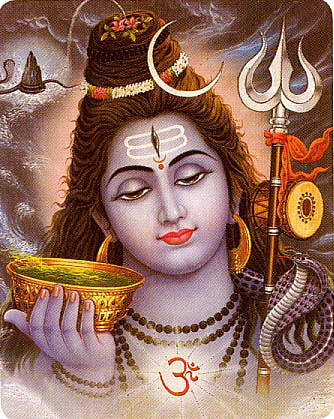
The Third Eye: Lord Shiva is known as the three eyed Lord or Tryambaka Deva. The sun is his right eye, the moon left while the third eye of Shiva on his forehead is the eye of wisdom. It is the eye that looks beyond the obvious. The third eye can search evil from anywhere and destroys it completely.

Half-Open Eyes: The half-open eyes show that the universes cycle in process. When the eyes are completely closed it signifies the dissolvent of the universe and when it is completely open a new cycle of creation begins.
Crescent: Shiva bears on his head the crescent of the panchami (fifth day) moon. This is placed near the fiery third eye and this shows the power of Soma, the sacrificial offering, which is the representative of moon. It means that Shiva possesses the power of procreation along with the power of destruction. The moon is also a measure of time, thus Crescent also represent his control over time.
The Cobra Necklace: This suggests that Shiva is beyond the powers of death and is often the sole support in case of distress. He swallowed the poison kalketu for the wellbeing of the Universe. The deadly cobra represents that “death” aspect that Shiva has thoroughly conquered. The cobras around his neck also represent the dormant energy, called Kundalini, the serpent power. The snake curled three times around the neck of Lord Shiva depicts the past, present and future time. The snake looking in the right direction of Lord Shiva signifies that the Lord's perpetual laws of reason and justice preserve natural order in the universe.
The Vibhuti: Vibhuti is a three line of ashes drawn on the forehead that signifies the Immortality of the soul and manifested glory of the Lord.

Tiger Skin: Lord Shiva is shown sitting on or wearing a tiger skin. The tiger is the vehicle of Shakti, the Goddess of power and force. Shiva is beyond and above any kind of force. He is the master of Shakti. The tiger skin that he wears symbolizes victory over every force. Tiger also represent lust. Thus sitting on Tiger skin, Shiva indicates that he has conquered lust.

The Elephant & Deer Skin: Shiva also wears elephant skins. Elephants represent pride. Wearing elephant skin, Shiva indicates that he has conquered pride. Similarly deer represent the flickering mind. Shiva wears deer skin which indicates that he has controlled the mind perfectly.
Rudraksha Necklace: ‘Rudra’ is the other name of Shiva. It also means strict or uncompromising and ‘aksha’ means eye. Rudraksha, the necklace worn by Lord Shiva shows that he is firm about his cosmic laws and to maintain law and order in the universe. The necklace has 108 beads, which symbolize the elements used in the creation of the world.

Damaru (Drum): A small drum with two sides alienated from each other by a thin neck-like structure represents the two utterly different states of existence, unclear and clear. When a damaru is shaken, the sound formed denotes Nada, the cosmic sound of AUM, which can be heard during deep meditation.

Trishul (Trident): A three-branched trident shown adjoining to Lord Shiva symbolizes His three fundamental powers will, action and knowledge. As a weapon the trident represents the instrument of punishment to the evil doer on all the three planes - spiritual, subtle and physical.

Nandi, the Bull: Nandi is said to be the vehicle of Lord Shiva. The bull represents both power and ignorance. Lord Shiva's use of the bull as his vehicle expresses the idea that He removes ignorance and bequeaths power of wisdom on His followers.

Subscribe to:
Posts (Atom)